Did you know chartering a plane can sometimes cost less per hour than a night in a fancy hotel suite? This fact surprises many people.
The cost for this exclusive travel experience varies a lot. It can range from $1,200 to $10,000 for every hour of flight.
This wide range includes everything from efficient turboprops to the most luxurious business jets. The final cost on your invoice depends on several key factors.
Forget the headlines that only talk about extreme luxury. This guide will demystify the real affordability of flying this way.
You will learn how to navigate the factors that influence your price. By the end, you’ll feel ready to plan your next trip with confidence.
Key Takeaways
- Hourly rates for charter flights can start as low as $1,200.
- The final price depends heavily on the type of aircraft you select.
- Multiple variables, like flight distance and amenities, affect the total cost.
- This mode of travel is often more accessible than popular media suggests.
- Understanding the pricing structure is the first step to planning a smart trip.
- You can enjoy significant time savings and a personalized experience.
Private Jet Charter Average Cost: Demystifying the Numbers
Getting to know private jet rental prices starts with understanding a charter invoice. The final cost isn’t just one number. It’s a mix of several specific costs.
Knowing these parts helps you become a smart buyer. You can look at quotes with confidence and ask the right questions.
Every charter quote has five main parts:
- Billable Flight Time
- Fuel Surcharge
- Crew Fees
- Landing, Handling & Incidental Fees
- Federal Excise Tax (FET)
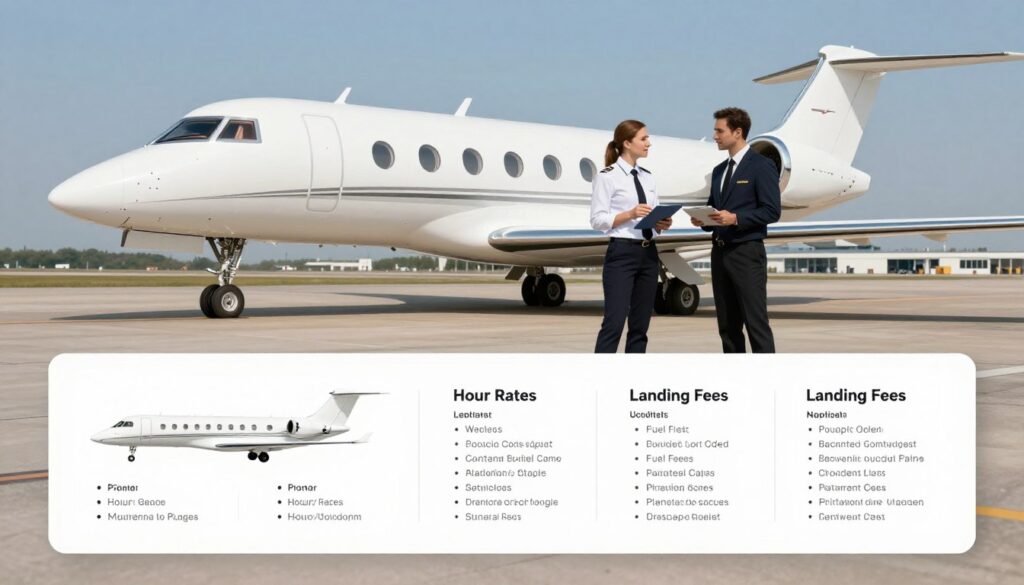
Billable Flight Time is the main cost. It’s not just the time flying from A to B. It also includes the jet’s journey to your departure airport. Most operators have a daily minimum, often two to four hours.
This means you pay for that minimum even if your flight is shorter. For a quick one-hour hop, you might be billed for three.
The Fuel Surcharge covers jet fuel costs. It changes with global oil prices. This fee is usually calculated per flight hour or as a percentage of the charter rate. It helps the operator avoid sudden market spikes.
Crew Fees cover the salaries and expenses for your pilot and cabin crew. These are usually fixed costs built into the hourly rate. For very long trips requiring multiple crew sets or overnight stays, additional fees may apply.
Landing and Handling Fees are paid by the operator to the airports you use. Busy major hubs like JFK or LAX charge significantly more than a small regional airport. “Handling” refers to ground services like parking, baggage handling, and using terminal facilities.
Incidental Fees can include overnight hangar costs for the crew or specific ground support requests.
Lastly, the Federal Excise Tax (FET) is a mandatory U.S. government tax. It applies to all domestic charter flights at a rate of 7.5% of the total fare, plus a small per-segment fee. This tax is non-negotiable and will appear as a separate line item.
When you look at private jet rental prices with this checklist, the quote makes sense. You see what you’re paying for: the aircraft’s time, the fuel to run it, the experts flying it, the airports you visit, and the required tax.
This knowledge is power. It allows you to compare quotes accurately, not just on the bottom line, but on how that total was constructed.
The 5 Major Factors That Drive Private Jet Rental Prices
The cost of renting a private jet is not random. It’s influenced by five main factors. Think of your quote as a puzzle with each piece affecting the final cost of renting a private jet. Understanding these factors helps you make better choices and save money.

1. Aircraft Category: From Turboprop to Ultra-Long-Range
Your choice of aircraft greatly affects the cost. It’s not just about size but also capability. A turboprop is great for short trips, while an ultra-long-range jet is perfect for long-distance travel. Each type has different costs, which affect your hourly rate.
The table below shows how different aircraft categories impact your budget based on your mission.
| Aircraft Category | Typical Seating | Hourly Cost Range | Ideal Mission | Key Cost Driver |
|---|---|---|---|---|
| Turboprop | 6-9 | $2,000 – $3,500 | Short regional trips, rough runways | Lower fuel burn, efficient engines |
| Light Jet | 6-8 | $3,500 – $5,000 | Quick city-to-city flights (2-3 hrs) | Balance of speed and operating cost |
| Midsize Jet | 7-9 | $5,000 – $7,000 | Transcontinental U.S. flights | Increased cabin space & baggage capacity |
| Heavy Jet | 10-16 | $7,000 – $10,000 | Long domestic & international routes | Higher fuel consumption, advanced systems |
| Ultra-Long-Range Jet | 12-18 | $10,000 – $13,000+ | Non-stop intercontinental travel | Maximum range technology & luxury amenities |
2. Flight Distance and Trip Duration
Longer flights might seem more expensive, but it’s not always true. Every flight has fixed costs like landing fees and crew time. These costs are spread over the total flight time.
Even short flights can have high per-mile costs. But on longer trips, these fixed costs become smaller, making the hourly rate more affordable. If the crew stays overnight, you’ll also pay for daily crew and hotel fees.
3. Route, Airports, and Positioning
Flying to certain airports can increase costs. Major hubs like Teterboro (TEB) or Van Nuys (VNY) have higher fees than smaller airports. Your choice here can affect your budget.
A hidden factor is aircraft positioning. If the jet isn’t already at your departure airport, it must fly there empty first. This “ferry leg” or “deadhead” flight is billable to you, adding to the total trip cost.
“Savvy flyers always discuss airport alternatives with their broker. Sometimes a 30-minute car ride from a smaller airport can save thousands in fees and avoid congested airspace delays.”
4. Timing: Last-Minute vs. Advance Booking & Seasonal Demand
When you book is as important as what you book. The laws of supply and demand apply directly to charter. Last-minute requests, for popular routes, often come with a premium.
Booking weeks or months in advance can lead to better rates. Seasonal peaks, like holidays or summer in the Hamptons, also increase prices due to high demand.
5. Amenities and Service Level
The final piece is customizing your experience. The base quote covers standard service. Upgrading to special catering, vintage wines, or ground transportation adds to your bill.
Requests for specific crews or additional flight attendants are possible but cost more. These options let you tailor your journey but also increase the price.
Private Jet Costs Per Hour: A Detailed Category Breakdown
Let’s dive into the hourly costs of different private aircraft. We use real data from operators for a quick reference. You can easily find the best fit for your budget and trip needs.
Remember, these private jet costs per hour are the base rate. Your final price will include extra fees, taxes, and services.
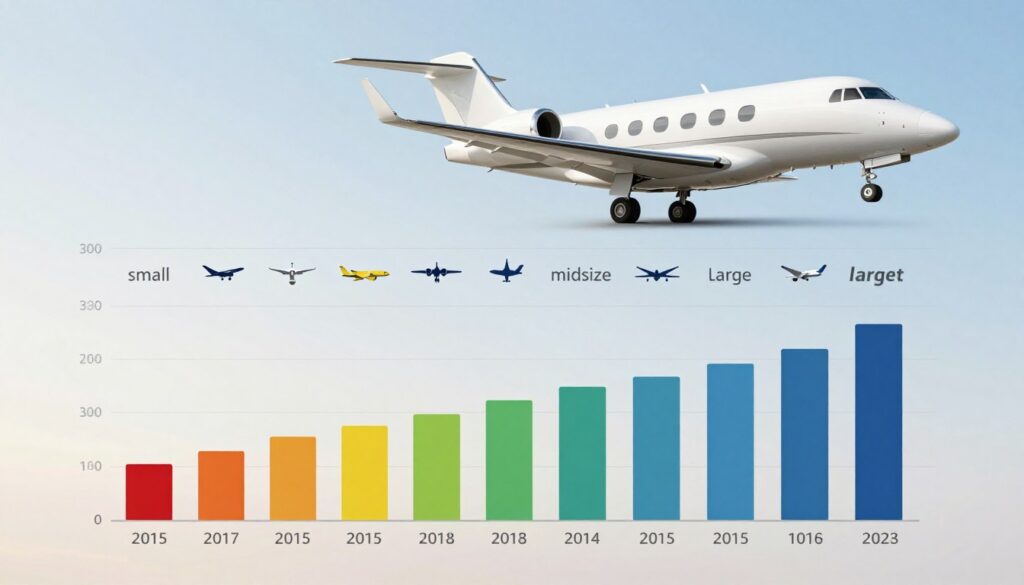
Very Light Jets (VLJs) and Turboprops: $2,000 – $3,500 per hour
This tier is great for short trips and small groups. You get cost savings but less cabin space.
- Turboprop Aircraft: Expect to pay $1,200 to $1,800 per hour. These planes are efficient for short flights.
- Very Light Jets (VLJs): Hourly rates are $1,500 to $2,250. Ideal for 2-4 passengers.
Both options are perfect for avoiding crowded airports. They can land at smaller airports near your destination.
Light and Midsize Jets: $3,500 – $6,500 per hour
This tier offers a good balance of comfort, range, and cost. It’s ideal for cross-country flights.
The cabin is spacious, with a private lavatory and more baggage space. Here’s a closer look:
- Light Jets: Costs range from $2,200 to $3,000 per hour. Seats up to 7 passengers for direct flights under 3 hours.
- Midsize Jets: Expect to pay $2,800 to $3,800 per hour. Offers a stand-up cabin, longer range, and more amenities for 6-8 passengers.
- Super Midsize Jets: Costs $3,800 to $5,000 per hour. Provides comfort similar to heavy jets with transcontinental range.
Heavy and Ultra-Long-Range Jets: $7,000 – $13,000+ per hour
This top tier is for long-distance travel, large groups, and luxury. The rates reflect extensive capabilities and premium interiors.
Heavy Jets start at $5,000 to $8,000 per hour. They have separate living areas, a full galley, and sleeping berths for 10-14 passengers.
Ultra-Long-Range (ULR) Jets are the most expensive, starting above $7,000 and reaching $13,000+ per hour. They can fly non-stop worldwide. They offer the largest cabins, master suites, and advanced entertainment systems.
Choosing this category means global reach and unmatched comfort. The price per hour is like flying a five-star hotel.
On-Demand Charter vs. Jet Membership Programs
When you compare private jet charter prices, you’re looking at two travel ways: flexibility and predictability. Your choice affects your costs, when you can fly, and your travel experience. This section explains the main ways to access private jets to help you choose the best one.
The on-demand charter is like paying as you go. You book a flight, agree on the price, and only pay for that trip. It’s very flexible, with no long-term deals or upfront costs.
This model is ideal for the occasional traveler. It’s great for special trips, business meetings, or family vacations. You pick the jet for each trip without any ongoing commitment.

For those who fly often, jet cards and membership programs offer better value. A jet card lets you buy a set number of flight hours on certain jets. You know the hourly rate, making budgeting easier.
These cards often come with guaranteed flights and simple billing. They’re a good middle ground between chartering and owning a jet, perfect for 25 to 50 hours of flying a year.
Jet membership programs and fractional ownership take commitment further. Companies like Surf Air offer unlimited flights in certain areas, like a private airline subscription.
At the top, fractional ownership programs, like NetJets, require a big upfront payment for a jet share. You get guaranteed access, managed flights, and a fixed cost for flying and management.
To see how private jet charter prices and features compare, check out the table below:
| Access Model | How It Works | Best For | Key Cost Consideration |
|---|---|---|---|
| On-Demand Charter | Book & pay per flight individually | Occasional travelers (under 20 hrs/year) | Hourly rate can vary by demand, route, and aircraft. |
| Jet Card | Prepay for a block of flight hours at a fixed rate | Regular flyers (25-50 hrs/year) | Significant upfront payment for hours; rate is locked in. |
| Membership/Fractional | Monthly dues or asset share for guaranteed access | Frequent flyers (50+ hrs/year) | Large upfront investment (fractional) or monthly fees; high predictability. |
So, which model fits you best? It depends on how often you fly. If you fly sporadically, on-demand charter is great for freedom. If you’re in the air often and want predictable costs, a jet card or membership might be better.
Understanding these access models helps you go beyond just hourly rates. You can make a choice that fits your lifestyle and budget.
Unlocking Affordable Private Jet Charters with Empty Leg Flights
Securing affordable private jet charters is easier than you think. It’s all about empty leg flights. These are game-changers for travelers with flexible plans.
An empty leg is like a taxi ride without a passenger. After dropping off clients, a jet flies back to its base. This is a chance for you to save big, as operators offer discounts to fill the seats.
Booking an empty leg can save you 50% to 75% on a charter. This makes affordable private jet charters a real option, not just a dream.
“An empty leg is the closest thing to a ‘sale’ in private aviation. It’s our way of giving you great value by matching a plane’s needs with your flexibility,” says an industry broker.
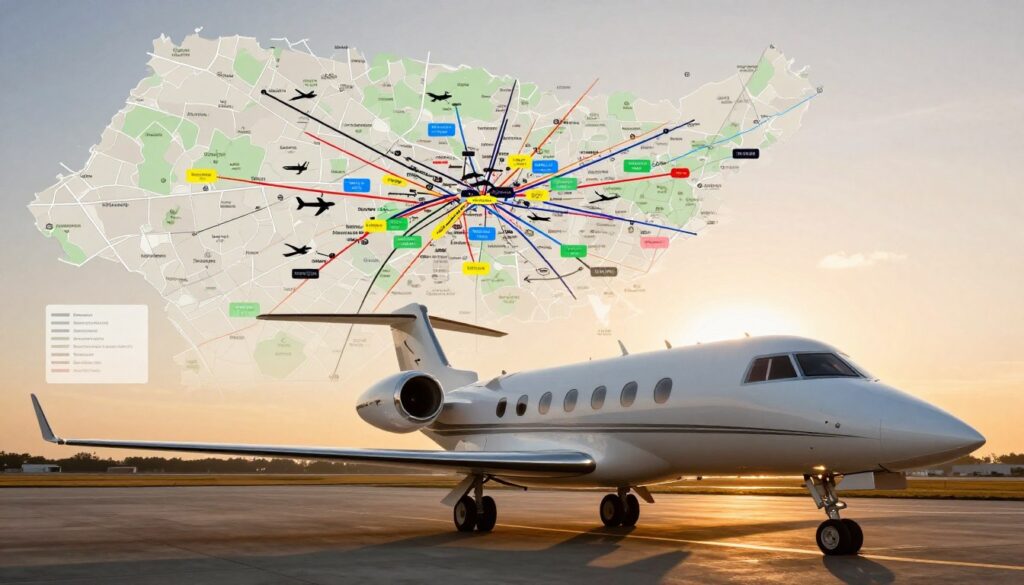
But, there’s a catch. Empty leg flights have fixed times and routes. You can’t change the schedule. If you’re flexible, the savings are huge.
Here’s a comparison to help you decide:
| Factor | Empty Leg Flights | Standard On-Demand Charter |
|---|---|---|
| Price | Extremely competitive, often 50-75% less | Full published rate |
| Schedule Flexibility | Very low; you adapt to the flight’s timing | Very high; you set the schedule |
| Route Options | Fixed; defined by the aircraft’s repositioning needs | Fully customizable; you choose origin and destination |
| Booking Process | Requires monitoring alerts and quick decision-making | Direct request and confirmation on your terms |
Finding these deals takes some effort. Use apps and platforms like Wheels Up for alerts. This way, you get the first chance at these deals.
Empty legs are a smart way to enjoy private travel. They can be as affordable as a first-class commercial ticket. For savvy travelers, they’re the key to affordable private jet charters.
Beyond the Quote: Decoding Additional Fees and Surcharges
Getting the real cost of luxury jet charter pricing means looking beyond the initial quote. The hourly rate you see first is just the start. Your final bill will include many other charges.
A good operator gives you a clear, complete quote upfront. If a quote seems too good to be true, it might not include all costs. It’s important to get clear information from your provider to avoid unexpected charges.

Let’s break down the common extras that affect your final bill. Knowing these helps you plan better and appreciate the full service you’re getting.
Federal Excise Tax (FET) and Segment Fees
These are fees you can’t avoid. The Federal Excise Tax (FET) is a 7.5% tax on the charter fare. It applies to every flight in the U.S.
Segment fees, or flight leg taxes, are charged for each takeoff. Each time your jet leaves an airport, you pay this fee. These costs are always on your bill.
Your charter broker should include these taxes in your first quote. Always ask for a detailed breakdown to understand how they affect the total charter costs.
Landing, Handling, and International Fees
Landing fees are paid to the airport for using the runway. Costs vary a lot. A busy airport like Los Angeles International (LAX) charges more than a small airfield in Aspen.
Handling fees cover services from the local Fixed Base Operator (FBO). This includes ramp access, passenger lounges, and baggage handling. International flights have extra charges.
These can include customs and immigration fees. When flying abroad, add these to your luxury jet charter budget.
Catering, Ground Transport, and De-icing Services
These are the premium services that make the luxury experience special. Gourmet catering tailored to your taste is a popular add-on. From champagne to multi-course meals, the options are endless.
Arranging ground transportation is a common convenience. Your operator can arrange luxury car service to meet you at the tarmac.
De-icing is a critical safety service in cold weather. It’s not optional when needed. This cost is based on the fluid used and can add a lot to winter flights.
| Fee Type | Typical Cost Range | Mandatory or Optional | Key Notes |
|---|---|---|---|
| Federal Excise Tax (FET) | 7.5% of charter fare | Mandatory | U.S. government tax on all charter flights. |
| Segment Fee | $50 – $150 per leg | Mandatory | Charged for each takeoff (flight segment). |
| Landing Fee | $100 – $1,500+ | Mandatory | Varies greatly by airport size and location. |
| Handling Fee | $200 – $800 | Mandatory | Covers FBO services at departure and arrival airports. |
| International Surcharge | $500 – $2,000+ | Situational | Includes customs, immigration, and handling abroad. |
| Gourmet Catering | $50 – $150 per person | Optional | Highly customizable; cost depends on menu selection. |
| Ground Transportation | Varies by vehicle & distance | Optional | Luxury car service arranged door-to-door. |
| De-icing Service | $1,000 – $3,000+ | Situational | Required in freezing conditions; billed per application. |
Looking at a detailed table like this helps you compare quotes better. It makes complex luxury jet charter pricing easier to understand.
Always ask for a complete quote that lists all fees. This clarity helps avoid surprises and lets you enjoy your flight. While these details add to the cost, they’re key to a seamless, premium experience.
Private Jet Charter Pricing in Real Life: Sample Trip Calculations
To really understand private jet charter pricing, nothing beats looking at real-life examples. Let’s apply what we’ve learned to actual trips. This makes complex numbers clear and shows what your bill will look like.
Imagine flying from Los Angeles to Aspen for skiing. You’ve picked a midsize jet for its comfort, range, and value. Here’s how the private jet booking rates work out for this route.
| Cost Component | Calculation | Amount |
|---|---|---|
| Flight Time (5 hours) | Midsize Jet Hourly Rate | $17,000 |
| Fuel Surcharge | Variable Cost | $550 |
| Crew Fees | Overnight & Service | $600 |
| Landing Fees | Aspen & LAX Charges | $750 |
| Subtotal | $18,900 | |
| Federal Excise Tax (FET 7.5%) | Tax on Subtotal | $1,417.50 |
| GRAND TOTAL | $20,317.50 |
Major factors like aircraft type and flight time are the base. Then, operational costs like fuel, crew, and landing fees add up. Lastly, a 7.5% FET is added to almost everything.

This example helps you estimate other trips. A short flight from New York to Washington D.C. in a light jet costs less. But, landing and handling fees become a bigger part of the total.
For a long trip, like Miami to Seattle, you need an ultra-long-range jet. The hourly rate goes up, but it’s over many hours. You also have to think about positioning costs for the aircraft.
Looking at these private jet booking rates examples helps you understand costs better. You can plan your own trip by considering distance and aircraft size. Then, add fees for your airports and services.
This practical exercise helps you go from curious to confident. When you ask for a real quote, you’ll know what each part is. This way, you can compare offers and ask the right questions to get the best deal for your trip.
How to Get and Compare Private Jet Booking Rates Like a Pro
Getting accurate quotes and comparing them is key to a great private jet deal. It’s like finding the best value. Treat it with the same care as any big investment.
First, decide how you want to shop. Working with a reputable charter broker is a smart move. They have connections to many operators, making it easy to get quotes.
Today, technology has changed the game. Digital platforms offer clear and fast information. This is a big improvement from just a decade ago.

Apps like Victor and JetASAP give you control. Victor has a clear fee and connects you to operators directly. This means straightforward pricing.
JetASAP works differently. You send in your trip details, and operators compete for your business. This can lead to great deals. It shows you the real price for your trip.
To get accurate quotes, give detailed information. Vague requests lead to useless estimates. Be ready with:
- Exact travel dates and preferred departure windows
- Number of passengers and luggage requirements
- Departure and arrival airports (including flexibility for nearby alternatives)
- Any special requests: catering, ground transportation, or specific aircraft features.
When quotes come in, compare them carefully. A lower rate might mean older planes or fewer extras.
Make a checklist for each quote. Check the aircraft’s make, model, and year. Also, confirm what’s included in the quote. Look at the operator’s safety and insurance.
The cheapest quote isn’t always the best. True savings come from knowing what you’re getting and if it fits your needs.
Look at the fee structure closely. Some include taxes and fees in the quote. Others add them later. To really compare private jet charter prices, calculate the total cost for each.
Don’t be afraid to ask questions. A good broker or operator will explain everything. This way, you’ll book with confidence, knowing you made a smart choice.
Proven Strategies to Manage and Reduce Your Charter Costs
Affordable private jet charters are within reach if you’re willing to embrace flexibility and think like an insider. You don’t need to compromise on the luxury or convenience that defines private air travel. By applying a few proven tactics, you can take control of the pricing variables and secure a better deal.

The journey to more affordable private jet charters begins with your schedule. Being flexible with your departure time by just a few hours can help you avoid peak slot fees at busy airports. Flying mid-week, like on a Tuesday or Wednesday, often costs less than a weekend flight. Even shifting your trip by a single day can unlock lower rates.
Your choice of airport is another powerful lever for savings. Major hubs like Teterboro (TEB) or Van Nuys (VNY) have higher landing and handling fees. Using a convenient alternate, such as Westchester County (HPN) for the New York area or Long Island MacArthur (ISP), can significantly reduce these costs. Less congested airports mean quicker turnarounds and lower ramp fees passed on to you.
How you structure your trip also matters. Planning a smart round-trip where you return within 24 hours can help you avoid overnight crew charges, which include hotel and per diem costs. If your schedule allows, booking a multi-stop itinerary on a single aircraft can be more efficient than two separate one-way charters.
To truly maximize value, you should actively hunt for empty leg flights. These are one-way flights where the aircraft is already scheduled to return to its base empty. Operators sell these seats at a deep discount—sometimes up to 75% off. The key is to be proactive:
- Sign up for empty leg alerts from several charter brokers and operators.
- Be ready to book quickly, as these deals are snapped up fast.
- Maintain flexibility on your destination and timing to match available routes.
Remember, every element of your trip is negotiable. Don’t hesitate to ask your broker about possible savings on catering packages or ground transportation. A collaborative approach with your charter provider can often reveal hidden opportunities to trim the final invoice.
By mastering these strategies—flexible timing, airport selection, smart trip planning, and empty leg vigilance—you transform from a passive customer into a savvy traveler. You gain the knowledge to navigate the market and secure the private flight experience you desire at a more manageable cost. The power to find value is in your hands.
The Intangible Value: Why Luxury Jet Charter Pricing is About More Than Money
For those who value every minute, luxury jet charter pricing is more than just a cost. It’s an investment in your most precious resource: time. The real value lies in what you gain, not just the price tag.

Think of it this way. Commercial flying is a transaction. You pay for a seat from point A to B. Private aviation, on the other hand, is an experience. You pay for time, peace of mind, and control. The difference is huge.
| Intangible Benefit | Commercial Travel Experience | Private Jet Charter Experience | Value for You |
|---|---|---|---|
| Time Saved | Hours in security, check-in, boarding, layovers. | Arrive 15 mins before departure. Direct to your aircraft. | Reclaims hundreds of hours yearly for work or family. |
| Control & Flexibility | Fixed schedule, rigid routes, frequent delays. | You set the schedule. Change plans with a phone call. | Master your calendar. Never miss a critical meeting. |
| Privacy & Confidentiality | Public terminals, crowded cabins, overheard conversations. | Total seclusion. Secure discussions. Discretion guaranteed. | Protect sensitive business deals or enjoy family time undisturbed. |
| Productivity & Well-being | Fatiguing, stressful environment. Limited work space. | Focused work or rest in a calm cabin. Arrive refreshed. | Turn travel time into productive time. Land ready to perform. |
Let’s talk about time. A single commercial round-trip can take 8 to 12 hours of your day. This includes driving, security, and delays. Over a year, that’s weeks of lost life. Private charter gives you that time back. You drive directly to the private terminal, walk onto your plane, and take off.
Control is another game-changer. Your flight leaves when you are ready. Need to extend a meeting or leave early? The schedule adapts to you. This flexibility is priceless for executives closing deals or families coordinating busy lives. You are no longer a passenger on someone else’s timetable.
“Flying privately isn’t a luxury for us; it’s a necessity. The ability to have my leadership team in three different cities in one day, discussing confidential strategy en route, is a competitive advantage that far outweighs the cost.”
Privacy is a cornerstone of the value. In a world where information is currency, conducting sensitive negotiations or having personal conversations in a public space is a risk. A private jet cabin is your secure, mobile office or sanctuary. This level of discretion is a core part of the luxury jet charter pricing proposition.
Lastly, consider productivity and well-being. You land feeling energized, not drained. The cabin is designed for comfort and focus. You can work, sleep, or relax without interruption. This means you arrive at your destination at your best, both mentally and physically.
For entrepreneurs, busy executives, and families, these intangible benefits justify the investment. It’s not about spending money. It’s about investing in your efficiency, health, and success. When you view luxury jet charter pricing this way, it becomes a powerful tool for a better quality of life and superior business results.
Using a Private Jet Cost Calculator: A Helpful Starting Point
Exploring private aviation costs starts with a simple step: using a private jet cost calculator. Many charter companies and aviation websites offer these tools for free. They give you a quick, rough estimate for your trip.
A private jet cost calculator is like your first financial guide. It sets the direction before you get into detailed talks. This tool helps you have realistic expectations from the start.
Using one is easy. You just enter some basic information about your trip:
- Departure and Arrival Airports: Your starting and ending cities or airport codes.
- Travel Dates and Times: When you plan to leave and return.
- Number of Passengers: How many people are in your group.
- Aircraft Category Preference: You can choose a type like “Light Jet” or “Heavy Jet.”
After you click “calculate,” the tool gives you a quote based on average rates and flight times. This number is a good starting point. It helps you see the cost difference between different types of jets for your route.
To understand what a calculator gives you versus the real cost, look at this comparison:
| Factor | Calculator Estimate Includes | Final Broker Quote Includes |
|---|---|---|
| Base Flight Cost | Estimated hourly rate x flight time | Real-time aircraft availability and market rates |
| Aircraft Positioning | Often not included | Cost to move the jet to your departure airport |
| Specific Fees & Taxes | Standard estimates or not included | Exact landing, handling, international, and FET fees |
| Trip Flexibility | Fixed inputs | Options to adjust dates or airports for savings |
The table shows the main difference. A calculator gives you a static snapshot. A broker offers a dynamic, real-time view. The final quote includes real-world details you can’t input online.
These tools are great for starting your trip planning. They’re perfect for testing different routes or dates to see their impact on the estimate.
But, always talk to a professional charter broker next. They have access to live inventory and can negotiate for you. Their quote will be the accurate, all-in price.
See the private jet cost calculator as a helpful, initial budgeting tool. Use it to guide your discussions and ask better questions. Then, work with an expert to make that estimate a confirmed, cost-effective trip.
Conclusion
Understanding private aviation is easier now. The cost of a private jet charter varies. It depends on your travel needs and choices.
Your choice of aircraft, how far you fly, when you book, and using deals like empty leg flights affect the price. Knowing these details lets you control your costs. This way, you can enjoy private jet travel without breaking the bank.
But the real value of private flying goes beyond the cost. It saves you time, offers privacy, and ensures your safety. For many, this peace of mind is worth more than the price.
With this information, you can confidently talk to charter companies or use a cost calculator. You’re ready to make smart choices. These choices will let you enjoy the unique experience of flying privately while keeping costs in check.