Did you know a pro team can lose over 200 hours each season waiting at airports? That’s like losing eight full days to delays.
Imagine getting that time back. Switching to a private jet service isn’t just about luxury. It’s a strategic investment in your team’s success and health.
Experts work non-stop to handle all the details. They focus on making your team’s travel smooth and worry-free. This gives your athletes a big advantage before the game even starts.
Key Takeaways
- Turn team travel into a competitive edge.
- Get back hundreds of hours for rest and prep each season.
- Boost player wellness with stress-free travel.
- Get 24/7 support from sports air charter experts.
- Enjoy door-to-door service for a game-ready team.
- Keep your team private, secure, and focused on the journey.
- Invest wisely for better on-field performance.
1. The Game-Changing Advantage of Private Air Travel
Imagine your team stepping off a bus and onto a private jet. They skip the chaos of a commercial terminal. This is real for forward-thinking teams. Private air travel changes sports team travel by saving time and energy.
Private air travel is more than luxury. It’s a smart choice that keeps your team focused. They avoid crowded spaces and long security lines. This helps them stay in top shape.

1.1. Leaving Commercial Headaches on the Tarmac
Commercial travel for sports teams is full of surprises. Think about the last time you faced:
- Long airport arrivals “just to be safe”
- Uncertain gate availability and last-minute terminal changes
- The risk of lost equipment or personal baggage
- Unavoidable public exposure and fan interactions during downtime
These issues add stress and distract your team. Private charter fixes these problems. Your team arrives early, walks straight to the jet, and knows their gear is safe. This quiet environment helps them stay focused.
1.2. The Ultimate Tool for Peak Performance
Removing travel headaches lets you focus on performance. A private jet becomes a mobile sanctuary for your athletes.
Players can follow their recovery routines right away. Some might study film in peace. Others can stretch or rest without being disturbed. This turns travel time into valuable preparation.
You control the aircraft environment. Adjust the temperature and serve meals that fit their plans. This ensures your team is ready to go, turning travel into a part of their training.
2. Private Jet Charter for Sports Teams: A Winning Strategy
Using private jet charter changes team travel from a hassle to a key advantage. For top teams, it’s not just a luxury but a vital part of their plan. This strategy focuses on three main areas that help your team win.

2.1. Maximizing Player Rest and Recovery
Private charters make flight time perfect for recovery. Athletes can stretch, drink water, and sleep in comfortable seats without airport noise.
This setup lets your medical and training teams follow specific routines in the air. Your players arrive feeling refreshed, not tired. They’re ready to play their best.
2.2. Unmatched Schedule Flexibility and Control
You decide the schedule. No more worries about last-minute changes or delays. Your professional sports charter flights leave when you want.
No more missed flights or rebooking headaches. This control reduces stress for coaches and managers. It makes travel reliable and predictable.
2.3. Protecting Team Privacy and Morale
A private jet keeps your team safe and private. Famous players avoid fans and media at crowded airports. This privacy helps them stay focused before games.
It also creates a space for team bonding. Coaches can brief, players can connect, and morale stays high. This travel experience strengthens the team’s bond away from distractions.
These three areas form a strong travel strategy. You manage the key factors that affect performance: rest, timing, and environment.
| Strategic Pillar | Primary Focus | Key Benefit for the Team |
|---|---|---|
| Rest & Recovery | Turning flight time into active recovery | Athletes arrive physically and mentally prepared |
| Flexibility & Control | Owning the departure and arrival schedule | Eliminates travel-related stress and uncertainty |
| Privacy & Morale | Creating a secure, team-only environment | Builds chemistry and protects focus from distractions |
Using professional sports charter flights gives your team a real edge. It lets them focus on the game, not getting to it.
3. How Professional Sports Teams Use Private Jets
Private jets are key for sports teams all year. They help with the regular season and tours around the world. It’s not just for looks; it’s a strategic tool for teams.
They can choose the right plane for a few people or the whole team. This includes staff and sponsors.

3.1. Regular Season Road Trips
The regular season is long. Private jets make long trips easier. Teams fly when they want, using smaller airports near games.
This saves time and helps players recover faster. They can even send equipment ahead and travel separately.
3.2. Critical Back-to-Back Games
Games on consecutive days are tough. Private air travel helps teams rest. They arrive early, sleep well, and are ready to play.
This small advantage can make a big difference in tight games.
3.3. International Preseason Tours and Exhibitions
Global tours are complex. Private jets make them easier. They offer space for players to rest on long flights.
The crew handles customs and immigration. This saves time and keeps the team focused.
3.4. Transporting Key Staff and Recruits
Not every trip needs the whole team. Private jets are great for staff, coaches, or recruits. They offer privacy and show commitment.
They’re also good for sponsors or family members. It’s a secure and comfortable way to travel.
In every case, the right plane is chosen. This makes private charter essential for teams.
4. The Core Benefits: More Than Just Luxury
The term “luxury jet services for sports teams” often brings to mind luxury. But the real advantage is in how it improves operations. It’s about making travel a tool for success, not a burden.
4.1. Time is Your Most Valuable Asset
In a busy season, saving time is key. Private jets help by making travel more efficient. This means more time for rest, practice, or planning.
4.1.1. Eliminating Airport Hassles
Forget the long lines and crowded terminals. Your team goes to a private FBO. Check-in is quick, and you go straight to the plane. This saves 2-3 hours per trip.
4.1.2. Flying Direct to Smaller Airports
Commercial flights use big airports. Private jets can land at smaller airports closer to your destination. This cuts down on travel time.

Travel time savings are huge. Here’s a comparison for a typical away-game trip:
| Travel Phase | Commercial Airline | Private Charter | Time Saved |
|---|---|---|---|
| Check-in & Security | 2.5 hours | 0.5 hours | 2.0 hours |
| Ground Transport to/from Major Airport | 1.5 hours | 0.5 hours | 1.0 hour |
| Flight Time (Including Taxi/Wait) | 3.0 hours | 2.5 hours | 0.5 hours |
| Total Door-to-Door Time | ~7 hours | ~3.5 hours | ~3.5 hours |
4.2. A Mobile Headquarters in the Sky
The cabin is a secure, productive space. It’s where travel helps your team perform better.
4.2.1. Strategy Sessions and Film Review
With fast Wi-Fi and space, coaches can meet. Players can watch game footage. It’s a private space for team talks.
4.2.2. Onboard Medical and Treatment Facilities
Trainers have room for treatments. They can manage recovery and monitor players. This is not possible on commercial flights.
4.3. Complete Control Over Your Environment
You control every aspect of the journey. This is key for keeping routine and morale up on the road.
4.3.1. Customized Cabin Layouts
Aircraft can be set up to your needs. Need more space for tall players? Want a medical area or a conference table? The layout is tailored before you arrive.
4.3.2. Tailored Nutrition and Catering
Team nutritionists plan the menu. Meals meet specific dietary needs. No airport or airline food limits here. Hydration and timing are perfect.
This level of customization turns the aircraft into a performance-focused travel ecosystem. Private aviation is not just luxury. It’s a tool that saves time, boosts productivity, and keeps athletes healthy. This is the true luxury of luxury jet services for sports teams.
5. Understanding the Aircraft: From Super Midsize to VIP Airliners
Knowing the different types of private planes helps you find the perfect one for your team. It’s not just about luxury. It’s about making smart choices that affect your team’s rest, travel, and teamwork.
Top providers have access to thousands of planes worldwide. Your job is to know what you need.

5.1. Midsize Jets: The Efficient Workhorse
Midsize jets are great for smaller teams or scouting trips. They have a comfortable cabin that seats 7 to 9 people.
These planes are fuel-efficient for short trips. They can fly across a continent without needing to stop for fuel.
They’re perfect for quick, affordable trips. They’re ideal for shorter journeys.
5.1.1. Popular Models: Hawker 800XP, Learjet 75
The Hawker 800XP is known for its reliability and spacious cabin. The Learjet 75 is fast, making trips quicker.
5.2. Super Midsize Jets: The Sweet Spot for Most Teams
Super midsize jets are often the best choice for private aviation for sports teams. They offer a good balance of range and space.
They can seat 8 to 10 people comfortably. They have a galley and lavatory. They can fly non-stop across the country.
For basketball or hockey teams, they’re perfect. They offer luxury without the size of a bigger jet.
5.2.1. Popular Models: Gulfstream G280, Bombardier Challenger 350
The Gulfstream G280 is known for its smooth ride and quiet cabin. The Bombardier Challenger 350 has a tall cabin and advanced tech.
“The right aircraft isn’t an expense; it’s an investment in our players’ readiness. When we step off the plane, we’re game-ready.”
5.3. Large Cabin / Heavy Jets: Long-Range Comfort
For international tours or coast-to-coast trips, large cabin jets are the best. They’re built for long trips.
They can seat 12 to 16 people in different areas. You’ll find lounges, bedrooms, and air purification systems.
They offer a “mobile headquarters” for long trips. Players can sleep, dine, and review game footage in their own area.
5.3.1. Popular Models: Gulfstream G650ER, Bombardier Global 7500
The Gulfstream G650ER is the top choice for long-range and speed. The Bombardier Global 7500 has the largest cabin and best altitude.
5.4. VIP Airliners: For Entire Rosters and Staff
VIP airliners are for teams with the whole roster, staff, and medical team. They’re modified commercial planes.
They can carry 50 to 150+ people in first-class style. They have spacious seating, meeting rooms, and lots of baggage space.
This option makes travel smooth for everyone. It’s the ultimate in private aviation for sports teams.
5.4.1. Popular Models: Boeing BBJ, Airbus ACJ
The Boeing BBJ and Airbus ACJ are common. They offer long-range travel and customization.
| Aircraft Class | Typical Passenger Range | Max Range (approx.) | Key Features | Ideal For |
|---|---|---|---|---|
| Midsize Jet | 7-9 | 2,500 nm | Cost-effective, fast turnaround | Small squads, regional scouting |
| Super Midsize Jet | 8-10 | 3,500 nm | Stand-up cabin, transcontinental range | Basketball, hockey teams |
| Large Cabin/Heavy Jet | 12-16 | 7,500 nm | Multiple zones, flat beds, dedicated lounge | International tours, long-season travel |
| VIP Airliner | 50+ | 6,000 nm | Full roster capacity, customized interiors | Football, baseball, soccer teams |
With over 15,000 planes worldwide, a skilled provider can find the perfect jet for your team. Whether it’s a small group or a whole team, there’s a plane for you.
Your choice affects your team’s performance. Knowing your options is key to a winning travel plan.
6. The Charter Process: From Inquiry to Touchdown
Forget the chaos of commercial travel. The private charter process is precise, personal, and performance-focused. It turns complex travel into a simple, five-step sequence managed by a dedicated expert. This lets your team focus on preparation, not airport navigation.

6.1. Step 1: Initial Consultation and Itinerary Planning
Your journey starts with a call or email. You’ll meet a dedicated flight manager or charter specialist. They become your single point of contact.
They’ll discuss your travel dates, team size, equipment needs, and airports. This conversation sets the stage for a seamless experience. They aim to understand your itinerary fully before finding the perfect aircraft.
6.2. Step 2: Aircraft Selection and Quote
Your flight manager searches for the ideal jet based on your needs. They present you with options that fit your team’s size, range, and comfort.
You’ll get a clear, detailed quote outlining all costs. This transparency is key. Reputable providers offer 24/7 availability for quotes and support. This step is about finding the right tool for the mission.
6.3. Step 3: Contract Signing and Pre-Flight Planning
After approving the quote, a formal charter agreement is prepared. Your specialist explains the contract to you. Once signed, detailed pre-flight planning begins.
Your flight manager handles the heavy lifting. They arrange catering, ground transportation, and hangar space. They confirm every detail, from WiFi to luggage handling.
6.4. Step 4: Day of Departure – Streamlined Procedures
Game day travel should be effortless. With private charter, your team avoids main terminal crowds. You go directly to a private terminal or Fixed Base Operator (FBO).
The check-in process is quick. Security is discreet and efficient. Your luggage is loaded directly from your vehicles onto the aircraft. Your flight manager ensures any last-minute changes are handled smoothly. You board on your schedule.
6.5. Step 5: In-Flight Experience and Arrival
Once airborne, the cabin becomes a mobile extension of your team’s facility. Players can rest, review strategies, or hydrate in a controlled, private environment. The crew is attentive to your group’s needs.
Upon landing, you deplane quickly. Ground transport is waiting steps from the aircraft, ready to take you to the hotel or stadium. This door-to-door efficiency is the final, critical advantage of choosing private jet charter for your team’s travel.
7. Key Logistics: Catering, Ground Transport, and Customs
For a sports team, the journey is more than just flying. It’s about every step from start to finish. The right sports team jet rentals provider takes care of all the details. This makes travel a smooth part of your winning strategy.

7.1. Designing the Perfect Sports Team Menu
Fueling athletes is a science. A top-tier charter service works with your nutritionists or chefs. They create a menu that boosts performance with lean proteins and complex carbs.
They also consider dietary needs and preferences. Meals are made to meet high standards, whether it’s gluten-free, vegan, or cultural cuisine. It’s not just airline food; it’s strategic fueling at 40,000 feet.
7.2. Seamless Ground Transportation Coordination
Once the aircraft door opens, the next phase starts. Luxury coaches, vans, or SUVs are ready, often right on the tarmac. This avoids the hassle of finding taxis or rental cars.
Your ground handler takes care of all the details before you land. Your team goes straight from the jet to the hotel or stadium. This service is part of a complete team travel solution.
7.3. Navigating International Customs and Immigration
International tours add complexity. An experienced charter provider handles customs and immigration paperwork in advance. They use FBOs where officials often clear your party ahead of time.
This means your team skips long queues at public terminals. You quickly present documents and move to your transport. This saves hours and keeps the team focused.
| Logistics Area | Comprehensive Sports Team Jet Rental Service | Basic Charter Service |
|---|---|---|
| Catering & Menu | Custom, performance-focused menus designed with nutritionists; accommodates all dietary needs. | Standard catering menu with limited or no customization for athlete diets. |
| Ground Transport | Pre-arranged luxury vehicles meet the team on the tarmac; dedicated coordinator. | May provide recommendations but leaves booking and coordination to the client. |
| Customs & Immigration | Manages all paperwork and arranges pre-clearance at private FBOs for swift processing. | Provides basic forms; team must clear through main airport terminals with the public. |
| Overall Experience | Fully managed, door-to-door journey that protects rest, privacy, and schedule. | Point-to-point flight only, leaving critical ground logistics as your responsibility. |
Mastering these logistics turns a simple flight into a powerful advantage. When every detail is coordinated, your team can focus on the game ahead.
8. Safety and Security: Non-Negotiable Priorities
When looking at private jet charter for sports teams, safety and security are key. They are not just nice-to-haves but must-haves. They are what set good providers apart from the rest.
Your hard work here keeps your athletes, coaches, and staff safe. This is your top priority.

8.1. Operator Certifications: Part 135 and ARG/US
First, check the operator’s certifications. In the U.S., they need a Federal Aviation Administration (FAA) Part 135 Air Carrier Certificate. This is the minimum.
But, you should also look for third-party safety audits. Check for ratings from Argus International (ARG/US) or Wyvern. These firms check on safety, pilot training, and maintenance.
A high rating from ARG/US or Wyvern is a big deal. It shows the operator meets high safety standards. Always ask for these certifications before you sign anything.
8.2. Aircraft Maintenance and Crew Standards
Then, look into how the planes are kept up and who flies them. Good operators follow strict maintenance rules, often more than the FAA requires. Ask about their fleet’s age and how they handle maintenance.
The crew’s skills are also important. Find out the pilots’ experience. For big airlines, captains have thousands of hours of flying. They also get regular training for stressful situations.
8.3. Security Protocols for High-Profile Passengers
For famous athletes, keeping things private is key. A top private jet charter for sports teams has special privacy measures. They use private FBOs instead of busy terminals.
These FBOs have private lounges and direct access to the plane. Many providers work with security firms for extra safety. They do threat checks and provide personal protection officers.
Every step of the journey is planned for safety. This lets your team stay focused on the game.
9. Cost Factors: What Determines the Price of a Charter?
The cost of a private jet charter for a sports team is clear. It’s based on several important factors. Knowing these helps you plan your budget better and understand the value of the price.

9.1. Aircraft Type and Size
The type of aircraft you choose is the biggest factor in cost. A small light jet is cheaper than a large super midsize jet. Bigger jets have more space and features, but cost more.
Choosing the right size jet is key. A big jet is not needed for short trips, but a small one might not be comfortable for long flights. Your charter advisor will pick the best jet for your sports team travel needs.
9.2. Flight Distance and Duration
Charter prices are based on “flight hours.” The longer you fly, the more it costs. A short flight is cheaper than a long one.
Remember, the clock starts when the jet leaves its base. This leads to the next big factor: positioning.
9.3. Positioning Flights (Empty Legs)
Often, the jet isn’t at your starting airport. The cost to fly it there is called a “positioning” flight. This fee is added to your total cost.
But, there’s a chance to save. When a jet needs to move after another charter, it flies an “empty leg.” You can get these one-way trips at big discounts. It requires flexibility but offers great savings for smart sports team travel planners.
9.4. Additional Services: Catering, Ground Handling, WiFi
The base charter rate covers the jet and crew. Everything else is customizable. You can add premium catering, ground transport, and fast WiFi.
These extras are listed separately. So, you only pay for what you want. Clear operators give you detailed menus and prices with no hidden fees.
| Service Category | Typical Options | Cost Impact |
|---|---|---|
| Catering | Performance meals, snacks, beverages | Moderate (per person) |
| Ground Handling | Limo/coach service, baggage handling | Variable (based on vehicle & time) |
| Connectivity | Basic WiFi, high-speed global internet | Low to High |
| Special Requests | Extra equipment space, last-minute changes | Case-by-case |
9.5. Understanding the Total Cost vs. Value Proposition
Looking only at the charter invoice misses the point. The real analysis compares it to the total cost of commercial sports team travel. This includes hidden costs like lost time in crowded terminals and the physical toll of connections.
Private charter makes your travel efficient and focused on performance. It turns wasted time into rest, strategy sessions, and team bonding. Seeing it as an investment in athlete readiness and control makes its value clear.
The final cost depends on your choices. Working with an expert helps you make the best choices. This way, you get a service that gives you the most value for your program.
10. Charter vs. Commercial: A Side-by-Side Comparison
Let’s look at the numbers side by side for private jet charter versus standard airline travel. For sports teams, it’s more than luxury. It’s about strategy, time, budget, and winning.

10.1. The Time Savings Analysis
Commercial travel wastes your most valuable resource: time. Imagine a road trip. Your team needs to arrive at the airport two hours early. You face long security lines and crowded terminals.
After landing, you wait for your gear and navigate busy baggage claim. A 90-minute flight can turn into a 6-hour journey.
With professional sports charter flights, you arrive at a private terminal 30 minutes before flying. You drive right to the plane. No lines, no waiting. Your gear is loaded directly. The same trip takes under 3 hours. You save half a day.
10.2. Cost Comparison for a Full Roster
At first, commercial first-class seems cheaper than charter. But consider the whole team—players, coaches, trainers, and staff. For 20+ people, those tickets add up quickly.
You also pay for extra baggage, last-minute ticket changes, and ground transport. Charter prices usually include everything.
The table below shows a realistic comparison for a team of 25 on a 500-mile trip.
| Factor | Commercial First Class | Private Jet Charter |
|---|---|---|
| Total Travel Time (Door-to-Door) | 5 – 7 hours | 2.5 – 3.5 hours |
| Cost for 25 People | $40,000 – $60,000+ | $35,000 – $50,000 |
| Baggage & Equipment | High fees, risk of loss/delay | Included, secure handling |
| Schedule Control | Fixed airline schedule | Depart on your timeline |
10.3. Impact on Performance and Outcomes
Commercial travel is stressful and draining. Players arrive tired, dehydrated, and exposed to crowds.
Charter travel offers a controlled environment. Players can rest, review game film, and eat meals focused on performance. They arrive ready, not exhausted.
This difference can be the edge between winning and losing. Seeing charter as an investment in peak performance makes the choice clear for elite teams.
11. Real-World Examples: Teams That Fly Private
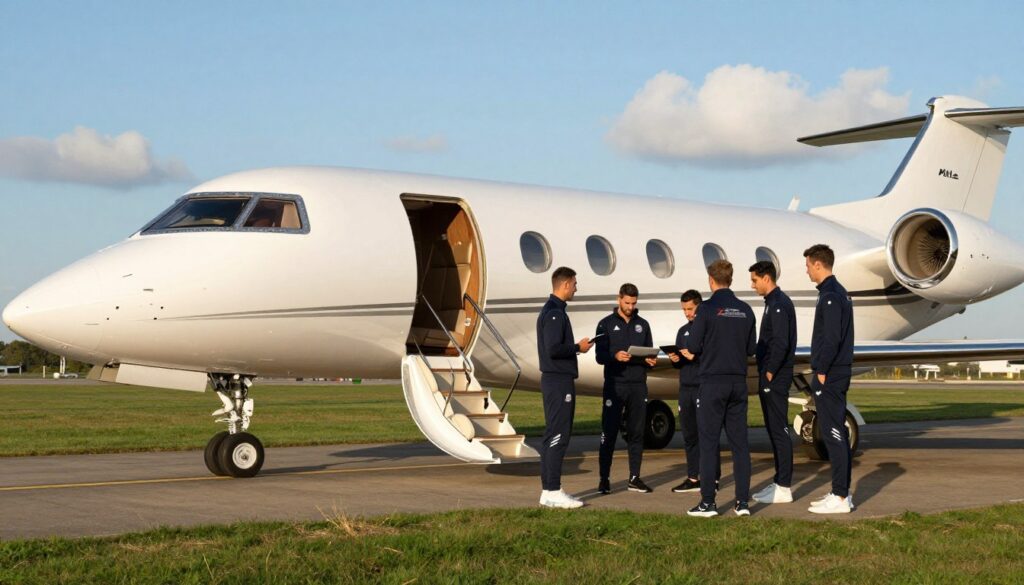
Private sports team transportation is not just for the rich. Top teams in sports use it to stay ahead. They see it as key to keeping players healthy and focused.
11.1. NBA Teams and Their Chartered Flights
The NBA’s schedule is tough. Teams play back-to-back games in different cities. Flying commercial would hurt their recovery.
So, every NBA team has a charter contract. They fly on their own plane right after games. This helps players recover better.
The plane is like a mobile recovery suite. It’s a must for the league’s sports team transportation.
11.2. NFL Teams Traveling for Away Games
For NFL teams, getting ready for games is all about precision. They can’t risk travel delays. Most teams charter flights for away games, leaving the day before.
This controlled travel helps with strategy meetings and focus. It also keeps players private and secure. Landing at smaller airports saves time, letting teams prepare better.
11.3. Premier League Soccer Clubs on Tour
Top European clubs, like those in the Premier League, have fans worldwide. They go on tours in the U.S., Asia, and Australia. Private air travel is key for these trips.
It lets teams travel together, controlling rest and training. This keeps players ready for important games that grow their brand.
11.4. Major League Baseball’s Long Season
MLB’s 162-game season is long and tiring. Teams travel a lot, which can affect their performance. So, they use chartered flights.
These flights offer a private space for players to relax and bond. Flying on the same plane helps maintain a routine. For baseball teams, a reliable private jet is as important as a good pitcher.
Choosing the Right Charter Provider: What to Look For
In the world of professional sports, not every charter provider fits your needs. Your aviation partner should work like an extension of your travel team. This choice affects player readiness and how smoothly things run.

Experience with Professional Sports Clients
Find a provider with a history of working with teams like yours. They get the season’s rhythm, the need for privacy, and how to move athletes.
A luxury jet services for sports teams expert has account managers who speak your language. They manage media, coordinate with equipment, and follow team rules.
Fleet Diversity and Availability
Your schedule changes fast. A good provider has the right plane ready when you need it. A diverse fleet is essential.
Can they offer a super midsize jet for a quick trip and a VIP airliner for a big team next week? True flexibility means having many aircraft options. This way, you get the right plane without overpaying or settling for less.
Transparency in Pricing and Operations
Surprises shouldn’t be in your travel budget. Ask for clear, detailed quotes that list every cost. A good operator promises the best price upfront.
Be wary of hidden fees in areas like:
- Landing and handling charges
- Overnight crew costs
- Specific catering requests
- Last-minute itinerary changes
Being open builds trust. It turns a vendor into a true partner.
24/7 Operational Support
Games can change, and weather can mess with plans. Your charter provider must offer constant support. A dedicated operations center should be ready to help, day or night.
This team keeps an eye on your flight, handles delays, and books new ground transport fast. They solve problems so you can focus on the game. This level of support is what sets top services apart.
Choosing the right provider is a smart move. The best luxury jet services for sports teams become a reliable, invisible force. They make travel smooth and help you stay competitive.
13. Contractual Considerations and Insurance
Your charter contract is like a rulebook for your flight. It outlines all the rules and protections for your team and the operator. When you choose private aviation for sports teams, understanding this contract is key. A good provider will explain each part clearly before you sign.
13.1. Key Clauses in a Charter Agreement
A good charter agreement is your first line of defense. It should clearly state the aircraft type and tail number. It also confirms the crew’s qualifications and payment terms. Make sure to check the liability and maintenance standards sections.
The Operational Control clause is very important. It must say the charter operator is in charge of the flight. This is a sign of a real Part 135 charter and protects your team.

It’s smart to have a lawyer look over the contract. They can make sure it meets your team’s needs and risk policies.
13.2. Cancellation Policies and Force Majeure
Game schedules can change quickly. Your contract’s cancellation policy explains the costs. Usually, you get a full refund if you cancel early (like 48-72 hours before). But, fees go up as the flight gets closer.
Always check the Force Majeure section. This part covers unexpected events like bad weather or air traffic control issues. A good contract lets you rebook or get a refund without extra fees in these situations.
13.3. Ensuring Adequate Insurance Coverage
Insurance in private aviation works both ways. A good operator has strong insurance for the aircraft and passengers. You should ask to see their insurance certificate.
Your team also needs to check its insurance. Make sure your travel and general liability policies cover private charter flights. This double layer of insurance keeps your team and assets safe.
| Clause Name | What It Covers | Why It Matters for Teams |
|---|---|---|
| Aircraft Identification | Specific aircraft model, registration number, and configuration. | Guarantees you get the exact plane size and amenities you selected for your roster. |
| Operational Control | Affirms the charter operator is solely responsible for the safe conduct of the flight. | Protects your team from operational liability and confirms a legal charter, not a grey-area arrangement. |
| Cancellation & Delay | Fees for cancelling and policies for delays outside the operator’s control. | Provides financial predictability for last-minute schedule changes common in sports. |
| Liability Limitations | Defines the financial limits of the operator’s liability for baggage, delays, or other incidents. | Helps your risk manager understand coverage gaps that may need supplemental insurance. |
| Force Majeure | Procedures for events like severe weather, war, or government actions that cancel travel. | Allows for flexible rebooking without penalty when unforeseen major disruptions occur. |
14. The Future of Sports Team Travel: Trends to Watch
Three big trends are changing the charter flights for sports teams world. They promise a future where travel boosts success. Teams are now focusing on more than just getting from point A to point B.
They want travel to help them perform better. Teams are using new tech to stay ahead of the game.
14.1. Sustainable Aviation Fuel (SAF) and ESG Goals
Going green is now a big deal. Teams are setting big goals for the environment, social, and governance. Private flying is answering with Sustainable Aviation Fuel (SAF).
SAF is made from renewable stuff. It cuts down on flight carbon. More companies are adding SAF to their options. This lets teams show they care about the planet.
14.2. The Rise of Membership and Jet Card Programs
Teams need to know their travel costs. This is why jet card and membership programs are growing. They give a set number of flight hours for a fixed price.
This makes travel costs easier to plan. It also means teams can fly whenever they need to. For many, these programs are a better deal than one-off charters.
14.3. Enhanced Onboard Technology and Connectivity
The cabin is becoming a high-tech hub. Ultra-high-speed satellite internet is key. It lets teams analyze videos, hold meetings, and track data in the air.
Top-notch phones keep everyone connected. New lighting helps players sleep better. This tech makes travel time useful for getting ready for games.
15. Conclusion
Your team’s travel strategy is like its playbook. Choosing sports team jet rentals gives you an edge. It makes travel time for recovery and eases logistical issues.
Teams that switch see a big difference. They arrive ready to compete, not tired from travel. Going back to commercial flights feels like a step down.
This investment in your athletes’ well-being is key to winning. It unlocks their best performance.
Now you know how to travel like a pro team. The next step is to act. Contact a charter provider with sports travel experience. Talk about your needs and get a quote for jet rentals. Your journey to better travel starts with this call.