
Did you know that the private aviation industry has seen a surge of over 30% in usage since 2020? This remarkable growth reflects a shift in how travelers perceive the value of time and convenience. While many think that flying on a private jet is only for the elite, it’s becoming more accessible than ever.
Understanding the pricing structure is crucial for anyone considering this travel option. Private jet flights are typically billed by the hour, with additional fees for services like catering and landing. This means that knowing the basics can empower you to plan your journey effectively.
In this guide, you’ll discover how various factors influence pricing, from aircraft type to peak demand. We will also introduce you to online cost calculators that provide instant quotes, making it easier to explore your options. By the end, you’ll feel confident navigating the world of private aviation and making informed choices for your next trip.
Key Takeaways
- Private jet travel is increasingly accessible for various budgets.
- Flight costs are primarily calculated by the hour, plus additional fees.
- Understanding the total pricing structure is essential for planning.
- Online estimators can help you get instant quotes for your trip.
- This guide will clarify factors affecting charter pricing.
Understanding the Cost of Private Jet Charter: What to Expect
The landscape of air travel is changing, with more people turning to private aviation than ever before. Understanding the costs associated with private jet charters is essential for effective travel planning. Knowing what to expect helps you budget wisely and avoid unexpected surprises.
When you grasp the factors influencing pricing, you can make informed choices about aircraft type, travel dates, and additional services. This knowledge aligns your travel plans with your financial comfort zone.
Why Knowing the Costs Matters for Your Travel Planning
Being aware of the expenses related to a private jet charter is the smartest way to plan your travel budget. This foresight can help you avoid any unexpected charges on your final invoice.
- Time savings: Arrive at a private terminal just minutes before departure.
- Flexibility: Adjust your departure times on short notice.
- Access: Fly to over 5,000 airports across the U.S., compared to just 500 for commercial airlines.
- Privacy: Enjoy a personalized experience with only your chosen passengers on board.
- Convenience: Skip long security lines and travel without the anxiety of delays.
While the initial price of a private jet charter may seem higher than first-class commercial tickets, the value lies in the time saved and the convenience gained. These benefits often justify the investment.
With the right planning and understanding of how pricing works, chartering a private jet can be an accessible option for both business and leisure travel. Think of it not just as a luxury but as a time-saving tool that transforms your travel experience.


How Private Jet Charter Differs from Commercial Flights
Unlike commercial airlines, private jet charters offer unmatched flexibility and efficiency. You can fly according to your schedule, avoid lengthy airport queues, and reach destinations that may not be serviced by larger aircraft.
In conclusion, understanding the costs associated with private jet charters is vital for planning your trips effectively. By recognizing the unique advantages of flying privately, you can make choices that enhance your travel experience.
Key Factors That Influence Private Jet Charter Costs
The world of private aviation is shaped by several key factors that determine your travel expenses. Understanding these elements can help you make informed decisions when planning your next trip.
Flight Time and Distance
Flight time and distance are the most fundamental cost drivers. Longer flights consume more fuel and require more crew hours. This directly increases the hourly billing total for your private jet charter.
Charter Destination and Airport Choice
Your charter destination and airport choice significantly impact costs. Landing at high-density airports like JFK or Miami International can incur fees over $1,000 per flight. In contrast, smaller regional airports may charge as little as $100.
Type and Size of Aircraft
The type and size of aircraft you select is a major pricing factor. Very light jets and turboprops offer economical options starting around $2,500 per hour. However, ultra-long-range jets can exceed $15,000 per hour.
It’s important to note that aircraft size isn’t the only consideration. Some smaller jets with extended range capabilities or premium features may cost more than larger but older models. Matching the aircraft to your specific trip needs is crucial.
Peak Demand and Scheduling
Peak demand and scheduling can also affect pricing. Flying to popular destinations during holidays or major events like the Super Bowl can drive prices up due to limited aircraft availability. Flexibility in your travel dates can help you avoid peak pricing.
Additional Services and Amenities
Additional services and amenities, such as in-flight catering, ground transportation, Wi-Fi access, and concierge services, enhance your experience but add to the final cost. Understanding these key factors empowers you to make informed trade-offs between comfort, convenience, and budget.
Discuss all these variables with your charter broker upfront to receive an all-inclusive quote that accounts for every aspect of your trip.
| Factor | Impact on Cost |
|---|---|
| Flight Time | Longer flights increase fuel and crew costs. |
| Airport Choice | High-density airports can incur significant fees. |
| Aircraft Type | Light jets are cheaper; larger jets are more expensive. |
| Peak Demand | Prices rise during holidays and major events. |
| Additional Services | Enhances experience but adds to total expenses. |

Breaking Down Private Jet Charter Fees and Taxes
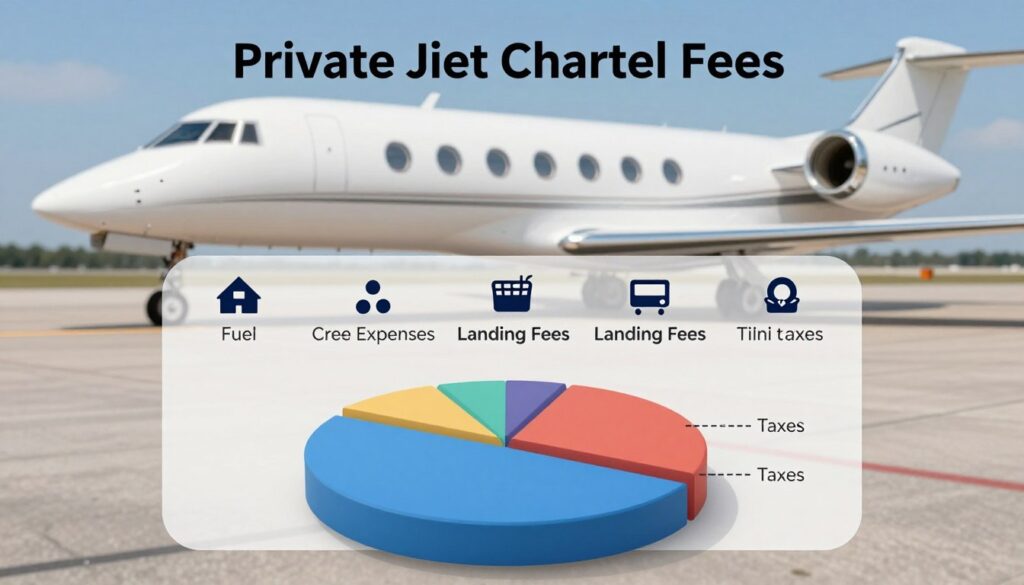
Understanding the fees associated with private aviation can significantly enhance your travel planning. Each charge contributes to the overall experience, and knowing what to expect can help you budget effectively.
Airport Landing and Handling Fees
Airport landing fees vary widely. Most executive and regional airports charge between $100 and $1,500 per flight. Major hubs like Boston Logan, Miami International, and JFK often exceed $1,000 due to their high traffic.
Additionally, ramp and handling fees from fixed-base operators typically range from $100 to $500 per flight. Sometimes, these fees can be waived if the aircraft meets minimum fuel purchase requirements.
Segment Fees and Federal Excise Tax
Another fee to consider is the segment fee, which is a small but mandatory charge of $4.50 per passenger for each flight segment within the United States. This fee supports air traffic control and aviation infrastructure.
Furthermore, a 7.5% Federal Excise Tax applies to all domestic flights. This tax is calculated based on the base charter amount and is a standard government-imposed cost.
Fuel Surcharges and Variable Costs
Fuel surcharges can also impact your final invoice. These surcharges start at around $300 per hour during market price surges. Since fuel prices fluctuate, this fee may vary based on current market conditions.
Other Potential Charges: Cleaning, Deicing, and Hangar Fees
There are other potential charges to keep in mind. De-icing fees can range from $1,500 to $15,000, depending on the size of the aircraft. Hangar fees typically cost between $500 and $1,500 per day, especially during winter months.
Cleaning fees start at $250 and can increase based on the level of service required. If you’re planning international flights, be prepared for additional costs of $500 to $5,000 or more for permits, customs, and immigration fees.
It’s wise to ask your charter broker for a detailed breakdown of all anticipated fees before booking. This transparency will help you budget accurately and compare quotes effectively.
Exploring Different Types of Private Jets and Their Costs
Private jets are available in various sizes and capabilities, allowing you to choose the best fit for your travel needs. Each type of aircraft offers unique advantages, from cost-effectiveness to luxury amenities. Understanding these options helps you make informed decisions for your trips.
Very Light Jets (VLJs) and Turboprops
Very Light Jets (VLJs) and turboprops represent the most economical entry point for private jet charters. Aircraft like the Cessna Citation M2 and Pilatus PC-12 offer hourly rates between $2,500 and $3,500. These jets are perfect for short regional hops of 1-2 hours.
Turboprops, such as the Pilatus PC-12, can complete short flights like New York to Boston for just $5,000 to $7,000, making them a cost-effective choice for ultra-short-haul journeys.
Light and Midsize Jets
Light jets like the Embraer Phenom 300 and Cessna Citation CJ3+ accommodate 6-8 passengers and cost between $3,200 and $5,500 per hour. These jets are ideal for 2-3 hour business trips, providing enhanced speed and comfort.
Midsize jets, such as the Bombardier Challenger 350 and Cessna Citation Latitude, offer stand-up cabins and enclosed lavatories. Their ranges of 2,700-3,400 nautical miles come at a price of $4,500 to $7,000 per hour.
Super Midsize and Large Cabin Jets
Super midsize jets like the Gulfstream G280 and Bombardier Challenger 300 provide larger cabins and transcontinental range at $5,000 to $7,500 per hour. These jets are suitable for coast-to-coast flights.
Large cabin jets, including the Gulfstream G450 and Bombardier Global 5000, accommodate 9-16 passengers with luxurious interiors. Their intercontinental range comes at a price of $7,500 to $13,500 per hour.
Long-Range and Ultra-Long-Range Jets
For those seeking the pinnacle of private aviation, long-range jets like the Gulfstream G650 and Bombardier Global 7500 are ideal. Capable of nonstop transoceanic flights, their hourly rates range from $9,000 to $19,000.
When selecting a jet, consider not just the hourly rate but also the aircraft’s range, passenger capacity, and amenities. This will ensure you choose the right jet for your specific travel needs.
| Type of Jet | Example Aircraft | Range (nm) | Hourly Rate ($) |
|---|---|---|---|
| Very Light Jets | Cessna Citation M2 | 1,550 | 2,500 – 3,500 |
| Turboprops | Pilatus PC-12 | 1,800 | 5,000 – 7,000 |
| Light Jets | Embraer Phenom 300 | 1,971 | 3,500 – 5,000 |
| Midsize Jets | Bombardier Challenger 350 | 3,200 | 5,500 – 6,500 |
| Super Midsize Jets | Gulfstream G280 | 3,600 | 5,500 – 7,500 |
| Large Cabin Jets | Gulfstream G450 | 4,350 | 8,000 – 11,000 |
| Long-Range Jets | Gulfstream G650 | 7,000 | 11,000 – 17,000 |
| Ultra-Long-Range Jets | Bombardier Global 7500 | 7,700 | 16,000 – 19,000 |

How to Use a Private Jet Charter Cost Estimator
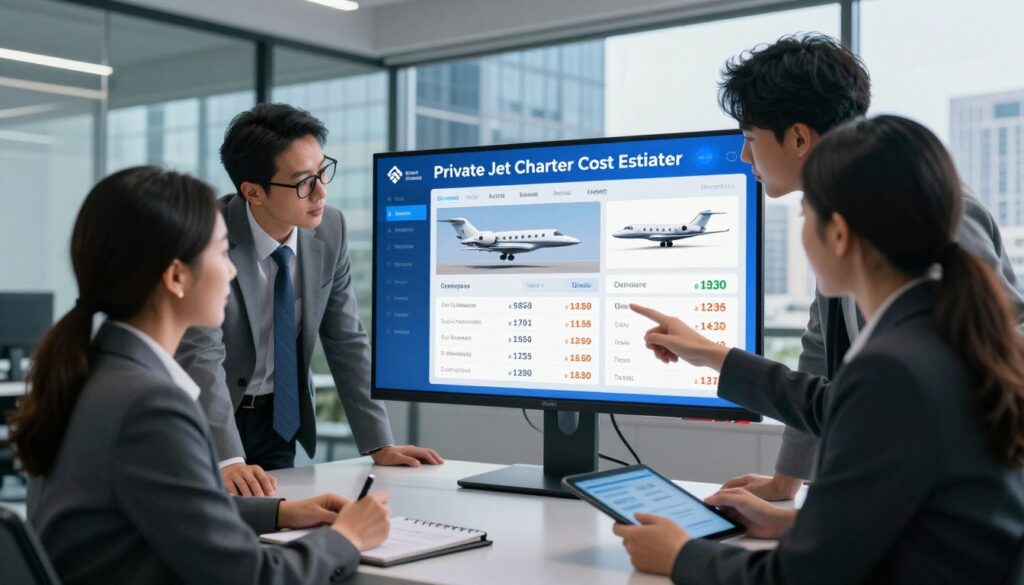
Using a private jet charter cost estimator can simplify your travel planning. This online tool allows you to input essential trip details and receive quick estimates for your flight expenses. Here’s how to make the most of it.
Inputting Your Trip Details for Accurate Quotes
Start by selecting whether your trip is a round trip, one way, or multi-city. This selection will tailor the estimator to your travel needs.
Next, input your departure and arrival locations. You can specify particular airports or cities, and the system will calculate the flight distance and suggest suitable aircraft options.
Don’t forget to enter your travel dates. Including both departure and return dates helps the estimator factor in seasonal pricing and aircraft availability.
It’s crucial to enter the correct number of passengers. This ensures the quote reflects the right jet size for your group, making your travel experience more comfortable.
Comparing Estimates Across Jet Types and Routes
After submitting your trip details, the estimator will provide instant estimated price ranges. A dedicated air charter agent will follow up with a personalized, all-inclusive quote tailored to your specific needs.
Take the time to compare estimates across different jet types and routes. For example, flying into a smaller regional airport instead of a major hub can significantly reduce landing fees and overall expenses.
Experimenting with flexible travel dates in the estimator can also unlock lower pricing during off-peak periods. A shift in your departure by a day or two might lead to better rates.
Remember, the cost estimator is a no-obligation tool designed to provide transparency. It helps you make informed decisions before committing to a booking.
For urgent trips, most charter brokers offer 24/7 phone support. You can speak directly with an agent for immediate assistance with your travel plans.
The Cost of Chartering a Private Jet: Hourly Rates & Examples
The pricing for chartering a private jet can differ greatly depending on the type of aircraft and the chosen route. Understanding these differences is crucial for effective travel planning.
For instance, a two-hour flight can range from approximately $8,000 for a turboprop to about $37,000 for an ultra-long-range jet. This wide range reflects the variety of options available in the private aviation market.
Let’s explore some real-world examples:
- A Pilatus PC-12 flight from New York to Boston costs between $5,000 and $7,000, making it an affordable choice for short regional hops.
- The Embraer Phenom 300E flying from Los Angeles to Las Vegas (about one hour) ranges from $9,000 to $11,000.
- A longer trip, such as from New York to Palm Beach, on the same light jet could cost between $15,000 and $20,000.
- For midsize jets, a flight from Palm Beach to Teterboro can run from $25,000 to $30,000.
- Cross-country travel, like New York to Los Angeles on a Gulfstream G150, typically costs between $30,000 and $35,000.
- The same journey on a faster Cessna Citation X may exceed $40,000, illustrating how performance impacts pricing.
- Super-midsize jets, such as the Bombardier Challenger 300, can cost between $40,000 and $50,000 for a five-hour flight from Atlanta to San Francisco.
- Heavy jets like the Gulfstream G450 can charge between $80,000 and $90,000 for transatlantic flights, such as New York to London.
- Finally, ultra-long-range options, like the Bombardier Global 6000, can exceed $190,000 for a trip from Los Angeles to Hong Kong.
When chartering a jet for an entire week, expect to pay tens of thousands to several hundred thousand dollars. This amount varies depending on flight frequency and aircraft choice. Often, it’s more economical to charter only for the days you actually fly.
Use these examples as benchmarks when evaluating quotes for your trips. Remember, actual prices depend on specific dates, availability, and any additional services you may request.
| Aircraft Type | Route Example | Estimated Cost ($) |
|---|---|---|
| Turboprop | New York to Boston | 5,000 – 7,000 |
| Light Jet | Los Angeles to Las Vegas | 9,000 – 11,000 |
| Light Jet | New York to Palm Beach | 15,000 – 20,000 |
| Midsize Jet | Palm Beach to Teterboro | 25,000 – 30,000 |
| Midsize Jet | New York to Los Angeles (Gulfstream G150) | 30,000 – 35,000 |
| Midsize Jet | New York to Los Angeles (Cessna Citation X) | 40,000+ |
| Super-Midsize Jet | Atlanta to San Francisco | 40,000 – 50,000 |
| Heavy Jet | New York to London | 80,000 – 90,000 |
| Ultra-Long-Range Jet | Los Angeles to Hong Kong | 190,000+ |

Additional Costs to Consider When Chartering a Private Jet
When considering a private jet experience, it’s essential to account for more than just the base fare. While the primary fee covers the aircraft and crew, several optional services can enhance your journey and should be factored into your overall budget.
In-Flight Catering and Concierge Services
In-flight catering can vary widely in price. Custom orders typically range from $230 to $2,000 per leg. Depending on your menu selections, you can choose anything from simple snacks and beverages to gourmet multi-course meals prepared by private chefs.
Ground Transportation and Accommodation for Crew
Ground transportation services can be arranged for $180 to $1,000 or more per reservation. This includes luxury sedans, SUVs, or limousines to ensure seamless door-to-door travel from home to the airport and onward to your destination.
If your itinerary requires pilots and flight attendants to stay overnight away from their home base, a per diem of $200 to $600 per crew member covers lodging, meals, and incidental expenses.
Wi-Fi, Special Requests, and Other Optional Fees
Wi-Fi charges can range from $2 to $9 per megabyte on domestic flights and may cost more internationally. Some operators include complimentary Wi-Fi access as part of the charter package, enhancing your experience.
Extended concierge services go beyond the flight itself. These include hotel bookings, spa reservations, restaurant arrangements, and event tickets. A custom quote is provided for approval before any charges are incurred.
Other potential fees include cleaning charges starting at $250, de-icing services ranging from $1,500 to $15,000 in cold climates, and hangar rentals at $500 to $1,500 per day during winter months.
To avoid surprises, discuss all desired services with your charter broker upfront. This way, the all-inclusive quote reflects every aspect of your travel experience.

Understanding Aircraft Positioning and Short Leg Fees
When planning your next flight, it’s essential to understand the nuances of fees that may apply. Two significant charges you might encounter are aircraft positioning fees and short leg fees. Knowing these can help you budget better and avoid surprises.
When and Why Positioning Fees Are Applied
Aircraft positioning fees occur when a private jet is not located at your departure airport. If the aircraft needs to fly empty to reach you, those costs are passed along to you, the charter client. This fee covers the fuel, crew time, and operational expenses involved in moving the aircraft from its current location to your airport.
Reputable charter brokers, like Stratos Jets, work to find aircraft that are already nearby. This can help minimize or even eliminate these fees, making your trip more economical.
How Short Leg Flights Affect the Final Cost
Short leg fees are charged for very brief flights, typically those under one or two hours. Takeoff and landing are the most fuel-intensive phases of a flight, causing greater wear on engines and airframes. Each time an aircraft takes off and lands, it advances its maintenance schedule, bringing it closer to costly inspections.
To offset these additional needs, operators often charge a premium for short hops. If your trip involves a very short flight, consider whether ground transportation might be more economical. You can also discuss with your broker about combining multiple short legs into a single itinerary to reduce per-leg fees.
While these fees may seem complex, a transparent charter broker will explain all positioning and short leg charges upfront in the quote. This way, you can plan your travel without unexpected surprises on the invoice.

Membership and Fixed-Rate Pricing Options
For those who frequently travel, jet card memberships and fixed-rate pricing can transform your flying experience. These options provide a compelling alternative to on-demand chartering, allowing for cost predictability and streamlined booking.
A private jet card membership works by allowing you to purchase a block of flight hours at a locked-in hourly rate. This protects you from market price fluctuations and peak demand surcharges throughout the year.
Benefits of a Private Jet Card Membership
- Predictable Pricing: You always know exactly what your hourly cost will be, making it easier to manage your travel budget without worrying about seasonal price spikes.
- Guaranteed Availability: Jet card memberships typically include guaranteed aircraft availability with as little as 24-48 hours’ notice, ensuring a private jet will be ready when you need it.
- Curated Fleet Access: Memberships often provide access to a fleet of aircraft that meet rigorous safety and quality standards, saving you time and effort in vetting operators for each trip.
- Flexibility: You can adjust your travel plans without the stress of unexpected pricing changes.
While fixed-rate pricing covers core flight costs, be aware that some ancillary operational expenses, such as concierge services or itinerary changes, may incur additional charges. This ensures you have the flexibility to customize your experience.
If you fly privately more than 25 hours per year, consider exploring jet card membership options. The combination of fixed rates, guaranteed availability, and simplified logistics can offer significant value.
To find the best fit for your travel patterns and financial preferences, download a jet card brochure or speak with a charter advisor. This way, you can compare membership programs and make an informed decision.

Booking Tips: How to Get the Best Price on Your Charter Flight
When it comes to securing a great deal on your next flight, a little flexibility can go a long way. Adjusting your travel dates or destinations can help you access lower rates and avoid peak demand pricing. This approach is one of the smartest strategies for anyone looking to fly privately.
For instance, consider flying midweek instead of on busy weekends. Fridays and Sundays often see higher demand, which can drive up prices. Additionally, steering clear of major holidays and event weekends can significantly lower your charter costs.
Flexibility in Travel Dates and Destinations
Being open to adjusting your travel plans is crucial. If you can shift your trip by even a day or two, you may find more affordable options. Airlines often have lower demand during the week, leading to better pricing.
Considering Empty Leg Flights for Savings
One of the best-kept secrets in private aviation is the availability of empty leg flights. These are one-way journeys where a jet is repositioning without passengers. Operators offer these flights at deeply discounted rates, sometimes up to 75% off standard prices.
When a jet is booked for a one-way trip, it must return to its home base or head to its next pickup location. Instead of flying empty, operators sell these legs at reduced rates to offset costs. However, be aware that availability depends on other clients’ itineraries, so flexibility is essential.
Choosing the Right Jet for Your Needs and Budget
Choosing the right aircraft can also lead to significant savings. For short trips, consider opting for a turboprop or very light jet instead of a midsize jet. This decision can dramatically cut costs while still providing a comfortable flying experience.
If you’re traveling with friends, family, or colleagues, sharing the charter fee can make flying private surprisingly affordable. Splitting the costs among multiple passengers allows everyone to enjoy the benefits of private travel without breaking the bank.
Lastly, working closely with an experienced charter broker can enhance your booking experience. They can alert you to empty leg opportunities, negotiate competitive rates, and recommend the most cost-effective aircraft for your specific trip.
| Tip | Description |
|---|---|
| Be Flexible | Adjusting travel dates can lead to lower prices. |
| Travel Midweek | Avoid weekends to access better rates. |
| Empty Leg Flights | One-way flights can be significantly discounted. |
| Choose the Right Jet | Opt for smaller jets for short trips to save money. |
| Share Costs | Traveling with others can make private flying affordable. |
| Work with a Broker | They can find the best deals and options for your trip. |

Comparing the Cost of Chartering vs. Owning a Private Jet
While the allure of owning a private aircraft is undeniable, the reality often reveals a different story. Many travelers dream of having their own jet, but the financial implications can be overwhelming. Understanding the true costs associated with ownership can help you make a more informed decision.
Purchasing a private jet involves a substantial upfront investment. The price can range from several hundred thousand dollars for a pre-owned turboprop to over $40 million for a luxury heavy jet like Jay Z’s Bombardier Challenger 850. However, this is just the beginning.
Ongoing operational expenses can accumulate quickly. These include:
- Pilot and Crew Salaries: These costs are unavoidable and can add up to hundreds of thousands annually.
- Hangar Storage Fees: Depending on location, these fees can be significant.
- Insurance Premiums: Protecting your investment requires a considerable insurance budget.
- Routine Maintenance: Regular checks and repairs are essential to keep the aircraft airworthy.
- Fuel Costs: These expenses can fluctuate based on market prices, impacting your overall budget.
Additionally, aircraft depreciation is another significant factor. Private jets lose value over time, and owners must budget for major overhauls and avionics upgrades to remain compliant with regulations.
In contrast, chartering offers a more flexible and financially sound option. With charter services, you pay only for the flights you take. This means no capital investment, no maintenance headaches, and no financial exposure when the aircraft isn’t in use.
Chartering also provides access to a diverse fleet of aircraft. You can select the perfect jet for each trip—a turboprop for a short hop or a heavy jet for a transatlantic crossing—rather than being limited to a single aircraft. This flexibility is a significant advantage for travelers.
Moreover, chartering eliminates the administrative burden of managing an aviation department. You won’t need to hire and train crew or coordinate maintenance schedules. Instead, you can simply enjoy the private flying experience.
For the vast majority of travelers, even those flying 50 to 100 hours per year, chartering offers superior flexibility, lower total costs, and greater peace of mind compared to the commitments of full aircraft ownership.
| Aspect | Owning a Private Jet | Chartering a Jet |
|---|---|---|
| Upfront Investment | Multi-million dollar purchase | No upfront cost |
| Operational Expenses | High (maintenance, crew, storage) | Pay per flight |
| Flexibility | Limited to one aircraft | Access to diverse fleet |
| Administrative Burden | High (management required) | Minimal (broker handles logistics) |
| Depreciation | Significant over time | No depreciation concerns |

How the Number of Passengers Affects Your Charter Cost
The number of travelers in your group can greatly influence the choice of aircraft and overall expenses. Each jet category has a specific seating capacity, which must accommodate your entire group comfortably. Understanding this can lead to smarter travel decisions.
A solo traveler or couple can fly economically on a very light jet or turboprop that seats 4-6 passengers. However, if your group consists of 8-10 people, you’ll need a midsize or super-midsize jet. Larger parties of 12-16 will require a heavy or ultra-long-range aircraft. As passenger count increases, the required aircraft size—and therefore the hourly rate—also increases.
Interestingly, while the total charter fee may rise with more passengers, the per-person cost often decreases. For example, a light jet flight costing $10,000 for two passengers works out to $5,000 per person. In contrast, a midsize jet flight costing $25,000 for eight passengers comes to just $3,125 per person. This demonstrates the efficiency of group travel.
Sharing the cost of a private jet charter with friends, family, or business colleagues can make the experience surprisingly affordable. Sometimes, it can even be comparable to first-class commercial tickets on a per-person basis. Therefore, it’s essential to consider the total group cost rather than just the hourly rate when evaluating charter options.
Choosing an aircraft too small for your group compromises comfort and may require limiting luggage. On the other hand, selecting one too large unnecessarily increases expenses. Accurate passenger counts are essential for optimal pricing.
Discussing your group travel plans with a charter broker can be beneficial. They can recommend the most cost-efficient aircraft that comfortably accommodates everyone while keeping the per-person cost as low as possible.
Impact of Seasonality and Peak Travel Times on Pricing
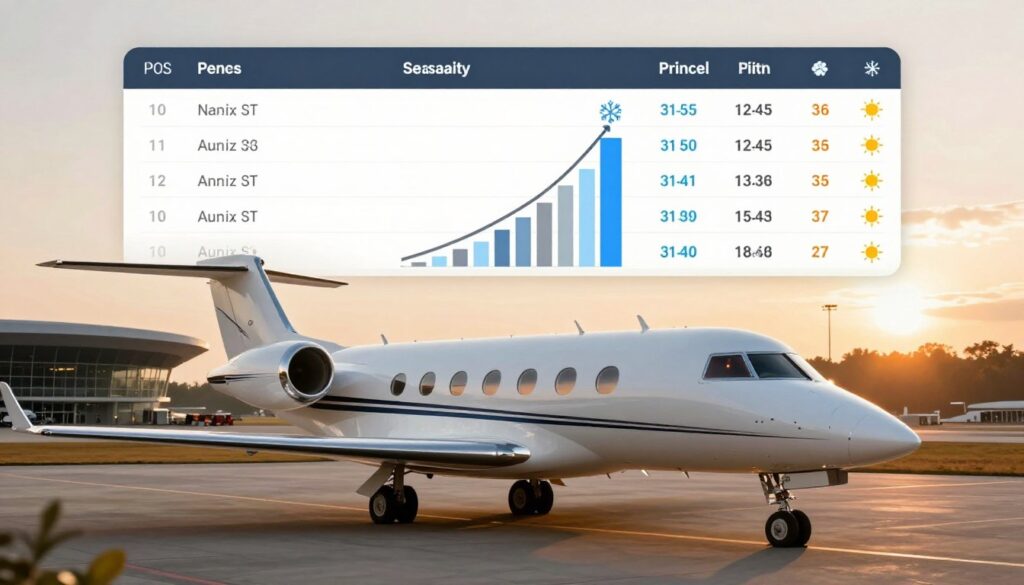
Understanding how seasons affect private jet pricing can help you plan your trips more effectively. Just like commercial airlines and hotels, private jet services see fluctuations in pricing based on demand. During peak periods, prices can soar, making flexibility key to saving money.
In the United States, major peak travel times include:
- Winter Holidays: Christmas and New Year’s are particularly busy, leading to higher rates.
- Spring Break: March and April see increased demand from families and vacationers.
- Summer Vacation: June through August brings a surge in leisure travel.
- Major Events: Events like the Super Bowl, Kentucky Derby, and Art Basel Miami can drive prices up significantly.
During these high-demand periods, aircraft availability tightens. Operators may charge hourly rates that are 20-40% higher than off-peak pricing. This makes planning and flexibility essential for travelers.
When to Book for the Best Rates
To secure the best rates, consider booking your charter flight well in advance—ideally 30 to 60 days ahead of peak periods. This advance planning gives you access to more aircraft options and better pricing before availability becomes constrained.
Navigating Peak Demand without Paying Extra
Traveling during shoulder seasons or off-peak days can also lead to significant savings. For example, consider flying midweek instead of on weekends. Avoiding the exact dates of major events can help you secure more competitive rates.
Another strategy is to fly into a nearby regional airport instead of the primary event airport. This can reduce landing fees and increase aircraft availability. Don’t hesitate to communicate openly with your charter broker about your budget constraints. Experienced brokers can often find creative solutions, such as sourcing aircraft from outside the peak demand zone or suggesting alternative travel dates.
With smart planning and a flexible mindset, you can enjoy the experience of flying private even during busy seasons without breaking the bank.
Private Jet Charter in the United States: What Makes It Unique
In the realm of aviation, private jet charters in the United States stand out for their unique advantages. The combination of regulatory structure, vast geography, and extensive airport network creates an unparalleled flying experience.
One key aspect to consider is the U.S.-specific taxes and fees associated with private jet travel. A 7.5% Federal Excise Tax applies to all domestic flights, while segment fees of $4.50 per passenger per leg help fund aviation infrastructure. Additionally, international flights incur a head tax of $19.70 per person for arrivals and departures.
Special tax considerations also apply for flights to Alaska and Hawaii, where a $9.90 per passenger head tax reflects the unique logistics of serving these remote states.
The incredible airport access available in the United States is another advantage. Private jets can utilize over 5,000 airports nationwide, compared to just 500 served by commercial airlines. This means you can land mere minutes from your final destination, avoiding congested hubs and dramatically reducing ground travel time.
This extensive airport network allows you to fly directly into small regional and executive airports that commercial airlines don’t serve. As a result, you can reach remote locations with runways too small for larger aircraft or that are not serviced by commercial flights.
The U.S. private aviation market is the largest and most competitive in the world. Thousands of charter operators and brokers compete for business, which helps keep pricing competitive and service standards high.
Moreover, U.S. regulations under the Federal Aviation Administration ensure rigorous safety standards for all charter operations. Reputable brokers only work with operators who meet stringent third-party safety auditing requirements.
To fully take advantage of the unique U.S. private aviation landscape, consider working with a knowledgeable charter broker. They can navigate the regulatory environment and help you find the best aircraft at the best price.

Common Myths and Misconceptions About Private Jet Charter Costs
The notion that private aviation is solely for the ultra-rich is a myth that needs debunking. Many people believe that flying privately is only for the wealthy elite, but that’s not the case. In reality, private jet charter and fractional ownership options are becoming more accessible to those who value their time and convenience.
While private jet services are premium, the per-person cost can be surprisingly competitive. When traveling in a group, you may find that chartering a private aircraft can match or even beat first-class commercial tickets on popular routes.
Is Flying Private Always Out of Reach?
It’s a common misconception that private flying is always more expensive than commercial options. In certain situations, such as last-minute travel or flying to remote destinations not served by airlines, chartering can actually be the more economical choice. This flexibility often makes private jets a smart option for many travelers.
Understanding What You’re Really Paying For
When you charter a private jet, you’re not just paying for transportation from point A to point B. You’re investing in time savings, privacy, and flexibility. You can conduct business or relax in a secure, personalized environment, enhancing your overall travel experience.
Another myth is that private jet charter involves hidden costs. Reputable operators provide all-inclusive quotes with full transparency about every fee and charge before you commit. This ensures you know exactly what you’re paying for.
Moreover, many modern aircraft are highly fuel-efficient. Chartering allows you to fly direct routes, minimizing total fuel consumption compared to connecting commercial flights. This makes private flying not only convenient but also more environmentally responsible than many believe.
Finally, booking a private jet is easier than you might think. With online cost estimators and 24/7 charter agents, you can get a quote in minutes and have an aircraft ready within hours. This accessibility makes private jet charter a practical tool for anyone who values their time.
| Myth | Reality |
|---|---|
| Only for the wealthy | More accessible than ever for various budgets. |
| Always more expensive than commercial | Can be economical for groups or last-minute travel. |
| Hidden costs | Reputable brokers provide transparent quotes. |
| Environmentally irresponsible | Modern jets are fuel-efficient and reduce total fuel consumption. |
| Complicated booking process | Easy with online tools and 24/7 support. |

Conclusion
Reflecting on the journey through private jet travel, you’ll find valuable insights that empower your choices. This guide has highlighted how accessible private jet charter is, with options ranging from economical turboprops to luxurious long-range jets. Understanding the variables that influence pricing—like aircraft type, flight distance, and passenger count—can help you secure the best deals.
We encourage you to explore our online cost estimator for instant, no-obligation quotes tailored to your travel needs. Working with an experienced charter broker can also simplify the process, ensuring you enjoy a seamless and enjoyable experience.
Remember, flexibility with travel dates and being open to sharing costs can significantly reduce expenses. Whether you’re planning a business trip or a family vacation, our dedicated air charter agents are available 24/7 to assist you. Don’t hesitate to reach out at (888) 593-9066 or email us at info@stratosjets.com to start planning your next adventure!